
Build #15 · Week 15 · Launched Sep 11, 2026
LiveBoring Millionaires
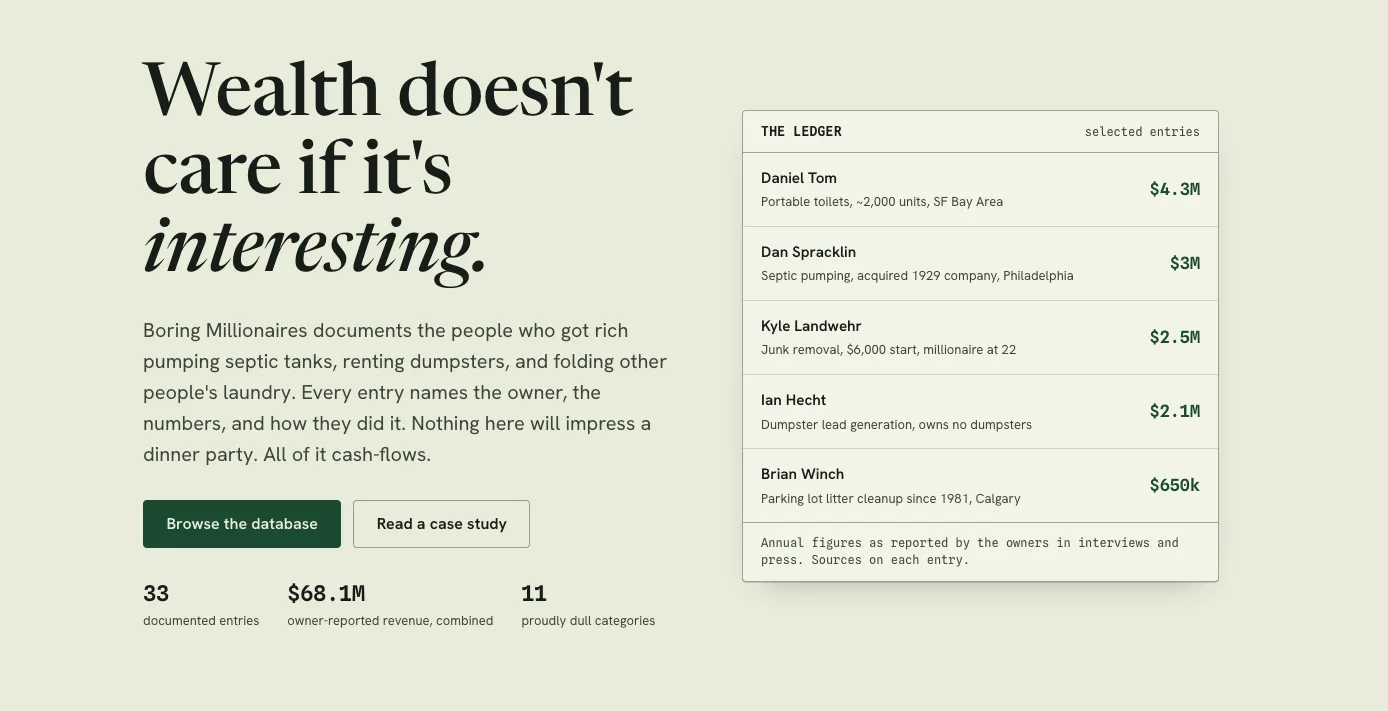
Wealth doesn't care if it's interesting. Boring Millionaires documents the people who got rich pumping septic tanks, renting dumpsters, and folding other people's laundry: every entry names the owner, the numbers, and how they did it, with sources linked. Nothing on it will impress a dinner party. All of it cash-flows.
The idea
What it is & why I built it
The internet is drowning in get-rich content about glamorous businesses that mostly don't work, while the people actually getting rich are pumping septic tanks in Philadelphia and cleaning parking lots in Calgary, largely undocumented. Boring Millionaires is the missing reference: a researched database of unglamorous wealth. Thirty-three case studies at launch, $68.1M in combined owner-reported revenue, eleven proudly dull categories, and the house rule that makes it citable: real names, real numbers, and sources on every single entry. No estimates, no hype, and, per the footer, enthusiasm withheld.
The pick honored the lean I announced Monday, another database, and the scoping lesson week 12 taught the hard way: the dataset has to fit the week. Thirty-three deeply-researched entries beats three thousand scraped rows, because in the AI-answer era the moat is not volume, it is verification. Every figure traced to an owner interview or press coverage is a fact AI engines can cite with confidence, and almost nobody else is doing that work for this corner of the economy.
And yes, the joke writes itself: a project whose whole brand is publishing boring honest numbers just built the reference work of boring honest numbers. It is the most on-thesis build in the portfolio, right down to the voice.
The build
How it was built
The dataset is the product, so the week went into research and structure rather than features. The centerpiece is the Boring Index, a 0-to-100 score with three weighted factors: glamour inverted (40%, "septic pumping has never been asked a follow-up question"), demand that ignores the economy (35%), and competition that never shows up (25%). Around the case studies sit aggregate research pages built from every entry at once: what it cost them to start ($150 to $3M, sixteen documented figures), what they actually keep (owner-reported margins by trade), and what they sell for (documented exits at 2.5-10x EBITDA). Plus an ideas index of 21 boring models and a picker tool that filters them by your budget and how you want to work.
The money model is the portfolio's first sponsorship play: the database stays free, and The Ledger, the site's own weekly newsletter shipping one new case study every Thursday, sells sponsor slots. That gives the build a second audience asset too, an email list of people specifically interested in unsexy profitable businesses, which is about as sponsorable as a niche gets. "Free. Unsubscribe whenever. We will never make it exciting."
Shipped Friday, on schedule, which after the week 12 dataset detour is itself a headline: this is the proof that database builds can live inside the weekly cadence when the scope is honest.
The numbers
Analytics so far
Launch-weekend zeros, counters live. The numbers to watch here are audience numbers first, sponsorship follows readers, and this niche has a rabid one on money-Twitter and money-Reddit. Case study count, Ledger subscribers, and the first sponsor dollar all land here as they arrive.
The recap
Lessons & results
Day-one lessons: the week 12 redemption is real, dataset builds ship on time when the dataset is scoped to the week, and verification beats volume as the moat. The open experiment is the model: this is the portfolio's first sponsorship business and its first build with its own newsletter, which makes it a long game by design. Whether The Ledger can turn boring into an audience, and an audience into sponsor dollars, gets answered here in public.