Build #14 · Week 14 · Launched Sep 4, 2026
LiveJotThread
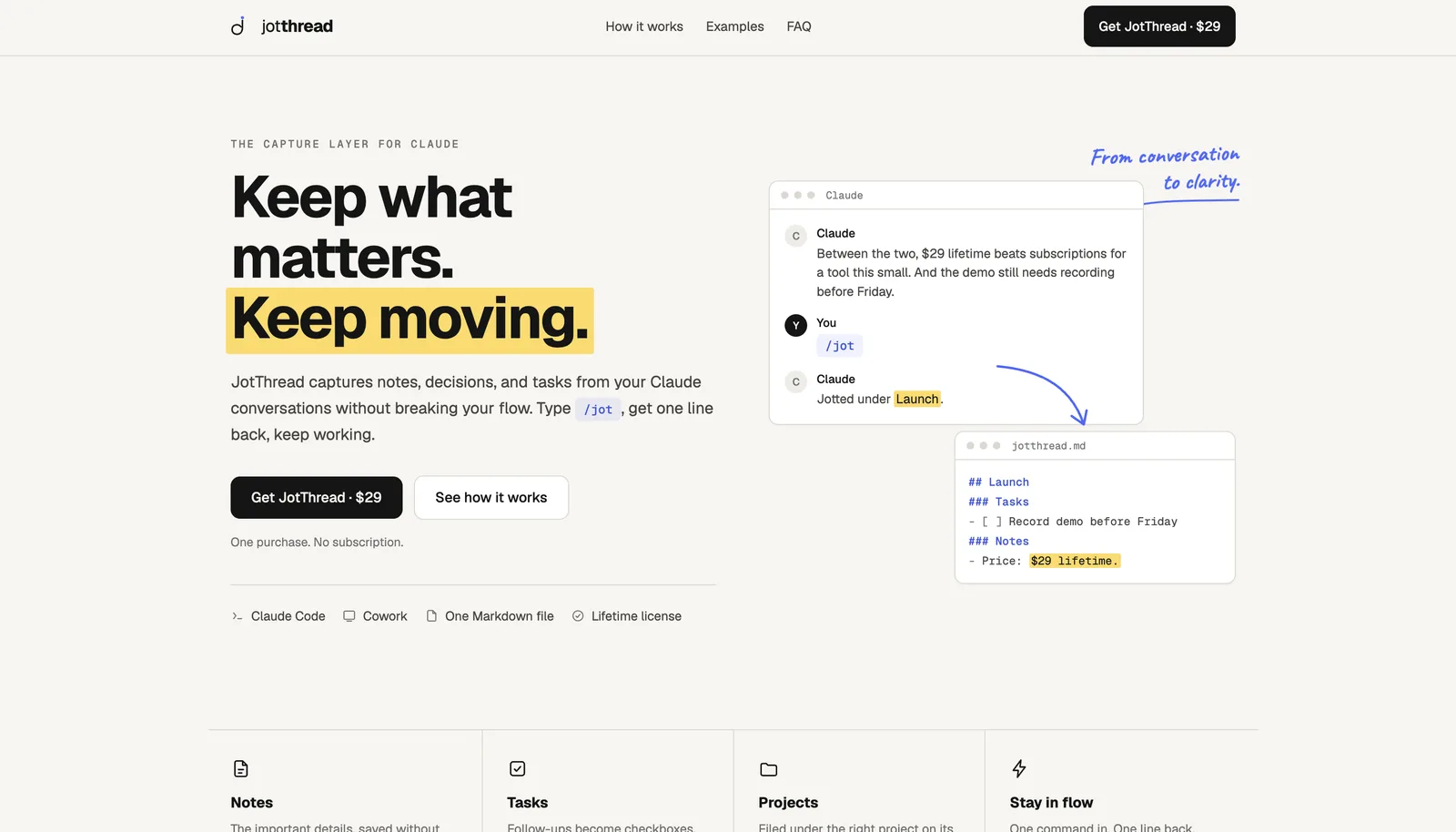
The capture layer for Claude. Mid-conversation, the useful stuff shows up: decisions, numbers, follow-ups, ideas. Then the session moves on and it's gone. JotThread fixes that with one command: type /jot, get one line back, keep working, and everything gets filed by project into a single Markdown file you own.
The idea
What it is & why I built it
Announced as "a Claude skill for organization," shipped as something more specific, because specific is what ships: JotThread is a capture tool, not a project manager. The insight came from living inside Claude all day for this project: the most valuable outputs of a working conversation are rarely the final answer. They are the decisions made in passing, the numbers agreed on, the follow-ups mentioned once. You already said it. Why type it again somewhere else? JotThread pulls those out before they scroll into the void, and decides on its own whether each one is a note or a task.
The philosophy is the same one running through this whole portfolio: you own the output. Everything lands in one Markdown file, jotthread.md, saved with your project. No account, no proprietary database, no server holding your notes hostage. Edit it by hand, commit it next to your code, back it up, move it. If you ever stop using JotThread, you lose nothing, your notes are still just a text file on your machine. That is the least extractive deal a note tool can offer, and it is deliberately the whole pitch.
And it stays out of the way by design: one command in, one line back. Type /jot and Claude reads the recent context and captures what matters, filed under the right project automatically. When you want the big picture, /thread renders the file as a clean board right in the chat, open tasks on top, notes underneath. The file is the source of truth; the board is just a view of it.
The build
How it was built
Third skill-economy product in a row, and the most refined expression of the pattern yet: the product is a skill file plus a Markdown convention, which means there is no backend, no hosting bill, and nothing that can go down. Nine commands total (/jot, /jot todo, /thread, /jj for the impatient, and friends), though the design bet is that you will mostly use one. It works everywhere the conversation happens: claude.ai, Claude Code, and Cowork, same commands, same file.
Pricing is one honest number: $29, once, lifetime, no free tier, sold through the SideRoad store like BuiltByBadge. "Just a small tool for a bigger you," as the pricing section puts it, and no subscription, because a capture tool this small charging monthly would be exactly the kind of extractive nonsense this portfolio exists to be the alternative to.
The week itself went to scope discipline: the temptation with an organization tool is to build a project manager, a calendar, a sync engine, and a philosophy. The FAQ on the site says the quiet part plainly: this is not a project management tool, it is a capture tool, and your project tracker stays your project tracker. Small on purpose, shipped on Friday, which after week 12's lesson is the only kind of scope that gets to play.
The money path
Where the revenue opportunity is
JotThread is the cleanest conversion test I have ever run: $29, lifetime, no free tier, so every single user is a buyer and the funnel has exactly one number in it. The market is heavy Claude users, a group that grows every month and hires their AI for organization a hundred times a week already. The opportunity is riding that wave early with a tool that costs nothing to serve, no servers, no support burden, pure margin per copy. If the skill economy supports paid-only products, this build finds out first, in public.
The numbers
Analytics so far
Shipped Friday, so these are weekend-old zeros with the counters live. The interesting test here is sharper than usual: no free tier means every user is a buyer, so the conversion story will be visible in one number. Copies, revenue, and visitors all land here as they arrive.
The recap
Lessons & results
Early lessons on record: the announced-vague, shipped-specific pattern worked again, "a skill for organization" became a capture tool with one job, and the scope survived the week because of it. The bigger experiment is pricing: JotThread is the portfolio's first no-free-tier product, a straight $29 ask, which makes it the cleanest test yet of whether the skill economy supports paid-only tools. Whatever the answer, it gets published here.