
Build #1 · Week 1
LiveMyNubs
A library of free, vet-guideline-backed calculators for dog and cat owners — built to rank in search and earn through relevant recommendations.
The idea
What it is & why I built it
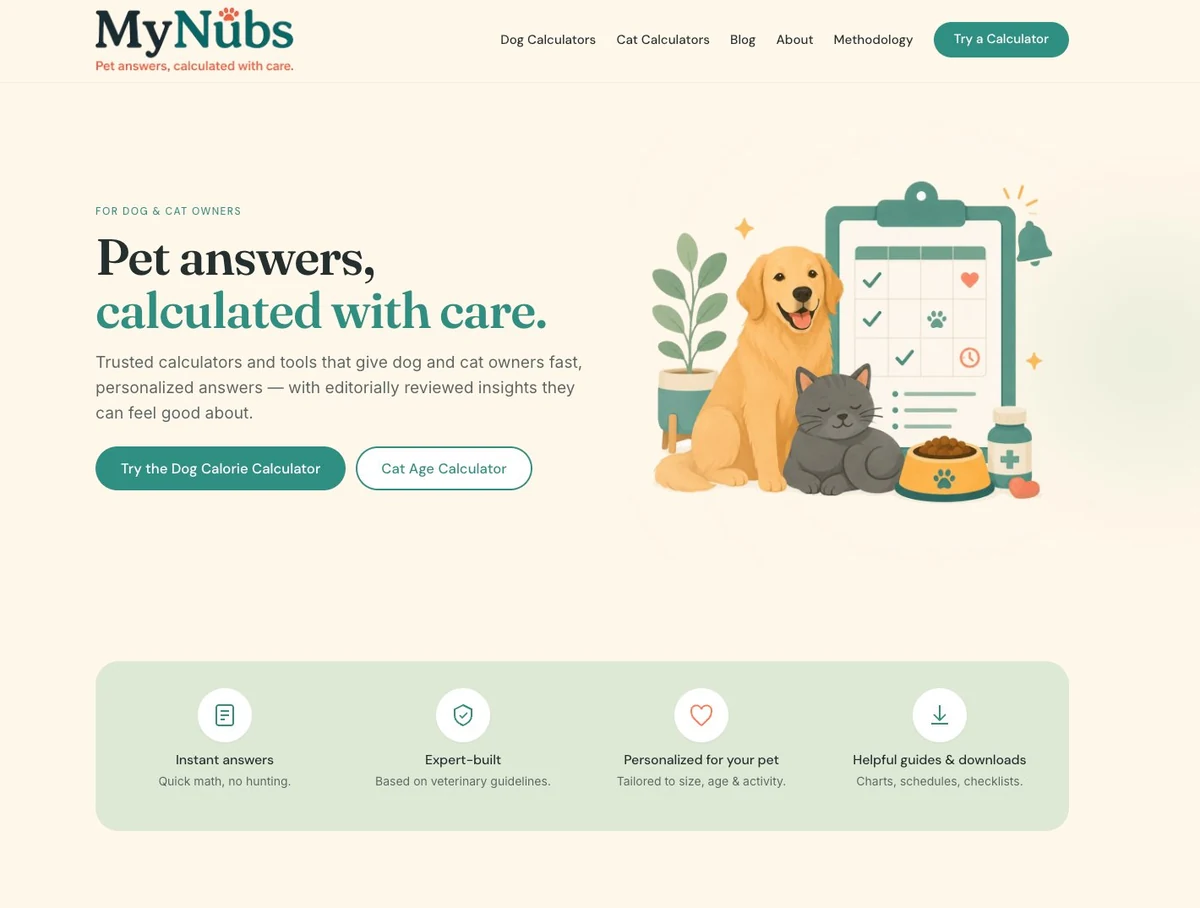
MyNubs is a library of free calculators for dog and cat owners — daily calorie needs, age in human years, ideal weight, food portions, and more. The thesis behind it is simple and well-proven: free interactive tools are some of the best organic-traffic magnets on the internet. People search for them constantly, other sites link to genuinely useful ones, and — unlike a blog post you have to keep refreshing — a good calculator keeps working with effectively zero ongoing effort.
Pet health is also a space where trust matters enormously, so every tool is built on published veterinary guidelines, with the formula and its sources shown right on the page. The plan is the same three-step engine behind most durable content businesses: get found through search, earn trust with tools that are actually useful, and monetize through relevant affiliate recommendations and display ads as traffic grows. It's the exact "tools as content" play I wrote about in creating content with AI that pulls in traffic.
The build
How it was built
MyNubs actually predates SideRoad — it was the build already in motion when I decided to start documenting everything in public, which makes it a fitting place to begin. The front end is hand-built and deliberately lightweight: calculators need to load instantly and work flawlessly on a phone, so there's no heavy framework getting in the way.
Each calculator pairs a vet-backed formula with a plain-English explanation, a quick-reference table, a short FAQ, and cited sources — so the page is useful whether someone runs the numbers or just reads. AI did the heavy lifting on the first drafts: structuring the formulas, writing the supporting copy, and generating the explanations. Then every number was checked by hand against the source guidelines, because "close enough" isn't good enough for anything health-adjacent.
This week isn't about adding features. It's optimization: tightening on-page SEO, strengthening the trust signals search engines reward for health content, fixing small inconsistencies between the calculators and their reference tables, and wiring up the first real revenue.
The stack
Tools used
Hand-coded front end Build
Plain HTML, CSS and vanilla JS — no framework — so every calculator loads instantly and works on any device.
AI assistant Content & logic
First drafts of the calculator formulas, explanations and supporting articles — then verified by hand against the source material.
Veterinary guidelines Sources
Published references like AAHA, WSAVA and the Merck Veterinary Manual sit behind every number, and are cited on the page.
Newsletter platform Audience
Capturing subscribers from day one so search traffic converts into an audience I actually own.
The numbers
Analytics so far
MyNubs just went live, so this dashboard is sparse on purpose — building in public means showing the zeros honestly. As organic traffic arrives from search, this section will fill in with real visitor counts, the top-performing calculators, conversion to subscribers, and revenue by source. No vanity metrics, no inflated numbers — the figures here will only ever go up because they actually happened.
The recap
What worked & what I'd do better
What worked
- The on-page foundation is genuinely strong — real vet formulas, cited sources, FAQs, and a 'when to call your vet' note on every tool.
- Tools-as-content is the right bet: each calculator targets a clear, high-intent search and keeps working with no ongoing effort.
- Built cheap with AI and free tiers, so it can earn its keep even at low traffic — there's almost no cost to recover.
What I'd do better next time
- Wire monetization in from day one — the calculators are perfect affiliate funnels and they shipped without any.
- Set up Search Console before launch, not after. You can't optimize what you can't measure.
- Line up a named, credentialed vet reviewer earlier — for pet-health content, that trust signal is the single biggest ranking lever.
- Build the supporting blog content alongside the tools, not after, to compound topical authority faster.