Build #16 · Week 16 · Launched Sep 18, 2026
LiveScammer Checker
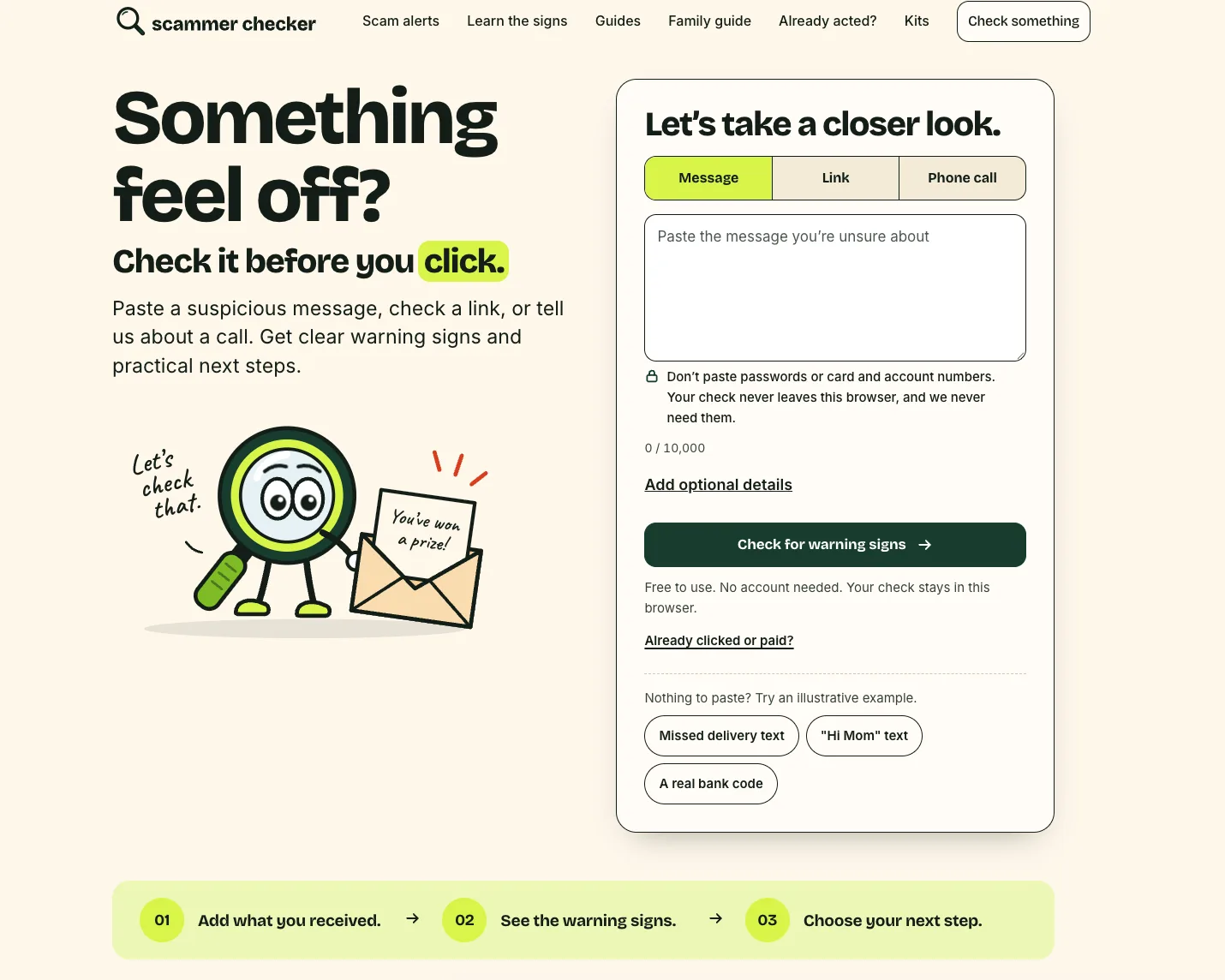
Something feel off? Check it before you click. Paste a suspicious message, check a link, or describe a call, and get the warning signs in plain English with practical next steps. Free, no account, and the check never leaves your browser. The money lives in printable kits: $19 for families, $499 for organizations.
The idea
What it is & why I built it
Everyone has stood in this exact spot: a text about a missed delivery, a call from "the bank," a message that is almost right, and that low hum of something feels off. Americans reported losing $15.9 billion to fraud last year, and the moment of maximum vulnerability is precisely the moment there is nowhere obvious to go. Scammer Checker is that somewhere: paste the message, check the link, or describe the call, and get the warning signs spelled out in plain English, with what to do next, including a whole path for the worst case, "already clicked or paid?"
Two design choices carry the trust weight. First, it runs entirely in the browser: nothing you paste is sent to a server, saved, or analyzed, which matters enormously for a tool people use in embarrassing moments. That is now the house pattern for sensitive tools, after Medicare Decoder and RSD Decoder. Second, and I love this one in an AI-everything portfolio: it is deliberately not AI. Results come from a published set of written rules, each with a plain explanation and a source, so the same input always gives the same answer. For a safety tool, deterministic and auditable beats clever, and the FAQ even refuses false comfort: no match reads "unable to establish trust," never "this is safe."
It also shipped content-complete, the biggest day-one library of any build: twenty guides (how to get money back by payment method, how to talk to your parents about scams), six pattern explainers with marked-up examples, and a dated, sourced scam-alerts feed. "Is this text a scam" is one of the internet's most evergreen question spaces, and this build showed up with answers on day one.
The build
How it was built
The free layer is the trust engine: the checker, the guides, the alerts, and a free eight-page printable family guide, no email required. The money layer is printable kits, and it is a two-tier bet. The Family Safety Kit at $19 is twenty pages for sitting down together: practice examples, a fill-in family plan, scripts for asking for help, a fridge checklist, contact cards. The Organization Scam Awareness Kit at $499 is a ready-to-run program for senior communities, home-care agencies, and advisers: a 30-minute workshop, staff guidance, handouts, a poster, and four weeks of emails.
That $499 line deserves its own sentence: it is the portfolio's first business-priced product, and a single sale of it would be worth more than everything the entire project has earned in seventeen weeks. It also aims at an audience the portfolio already courts, the people protecting aging parents, which is exactly Medicare Decoder's crowd, with enrollment season three weeks away. Two products, one audience, one seasonal window. That convergence was not planned, and it is the best strategic accident on the board.
One more first, small but meaningful: the footer reads "A Sideroad project," with a link home. Sixteen builds in, the portfolio has started signing its work, which is the BuiltByBadge thesis, sites that know about each other, applied to itself.
The money path
Where the revenue opportunity is
Scammer Checker has the widest price spread in the portfolio and the first B2B number: $19 family kits for the protect-your-parents crowd, and a $499 organization kit that senior communities and home-care agencies can expense without a meeting. One org sale would out-earn the entire project to date, and unlike SEO, that sale can be hand-worked starting today, those organizations are findable and emailable. Meanwhile twenty guides sit in search compounding toward the evergreen question, is this a scam. Free trust up front, two honest price tags behind it.
The numbers
Analytics so far
Launch-week zeros, counters live. The search surface is the long game here, twenty guides pointed at evergreen scam queries take months to rank, but the org kit can be sold by hand starting now: senior communities and home-care agencies are findable, emailable, and budget-holding. Kit sales, visitors, and the first $499 all land here as they arrive.
The recap
Lessons & results
Day-one lessons: launching content-complete beats launching tool-only, because the guides are the acquisition and the checker is the retention. Deterministic-and-sourced beats AI for a trust product, a lesson worth its own post someday. And the pricing experiment matters beyond this build: $19 and $499 against the same free layer is the portfolio's first test of consumer versus B2B economics on identical content. Results land here, honestly, as always.